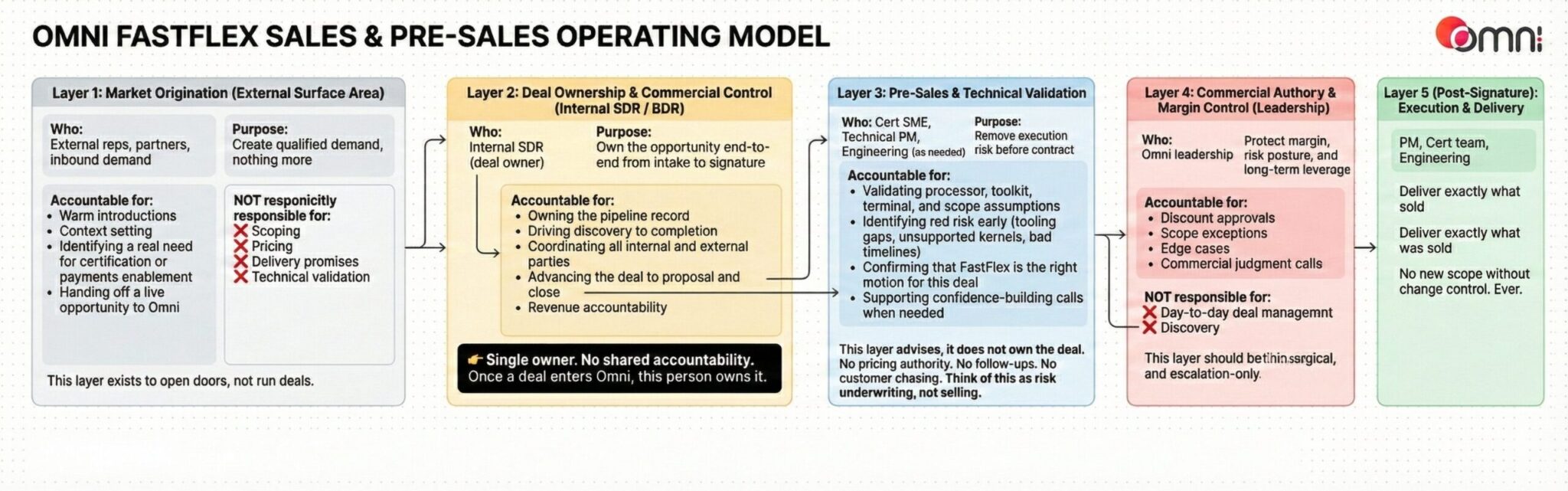
Omni Enterprise Sales Pre Sales Operating Model
This page defines how Omni sources, qualifies, sells, and transitions FastFlex opportunities into execution. It is designed for Omni leadership, internal SDR, certification SMEs, technical PMs, and external sales partners under NDA. The goal is simple: create a repeatable revenue engine without compromising delivery quality or margins.
Operating Principles
- Single Owner: Every opportunity has one internal owner. The internal SDR owns the deal once it enters Omni.
- Structured Discovery: Use the FastFlex Discovery Checklist to eliminate ambiguity early.
- Clear Stage Gates: A deal only advances when required inputs are present and risks are acknowledged.
- No Shadow Sales: SMEs and PMs advise and validate. They do not run the customer relationship or negotiate commercial terms.
- Execution Protection: We do not close deals that create uncontrolled delivery risk or margin collapse.
Hierarchy Overview
The sales system is organized into five layers. Each layer has a distinct purpose and clear boundaries.
| Layer | Primary Goal | Primary Actors | Core Responsibilities | Explicit Non Responsibilities |
|---|---|---|---|---|
| Layer 1: Market Surface | Originate qualified opportunities | External Sales Reps, Omni Leadership, Inbound | Identify real buyers and timelines, frame the problem, position Omni as the trusted execution partner, deliver warm introductions with basic context | Deep scoping, pricing commitments, tool or processor debates, delivery promises |
| Layer 2: Sales Control and Ownership | Convert signal into signed revenue | Internal SDR | Own opportunity end to end, run structured discovery, maintain pipeline hygiene, drive follow ups, coordinate internal resources, set and manage customer expectations | Over customizing scope without validation, committing to exceptions without approval |
| Layer 3: Pre Sales Validation | Remove execution risk before contract | Certification SME, Technical PM, Engineering as needed | Validate scope assumptions, confirm processor and tooling constraints, identify red flags early, support confidence building calls, protect delivery margins | Owning customer follow ups, negotiating commercials, redefining deal ownership |
| Layer 4: Commercial Authority | Protect pricing integrity and risk posture | Omni Leadership | Approve pricing exceptions, approve discounting outside guardrails, approve material scope deviations, resolve escalations | Running day to day follow ups, driving technical scoping calls unless escalated |
| Layer 5: Execution | Deliver what was sold | Program Manager, Cert SME, Engineering, Customer Team | Execute intake, coordinate certification activities, manage dependencies, report status, achieve analyst sign off and project completion | Re negotiating scope informally, accepting new work without change control |
Deal Ownership Rules
- External reps introduce opportunities and support positioning. They do not own the opportunity inside Omni.
- Internal SDR becomes the opportunity owner the moment the deal is accepted into Omni’s pipeline.
- Pre sales resources are pulled in by the SDR to validate risk, confirm assumptions, and support close.
Escalation Triggers
Any of the following requires pre sales validation or leadership review before the proposal is finalized:
- Processor is unknown or customer is guessing
- Tooling is unclear or requires non standard kits
- Unattended, kiosk, transit, or other higher risk use cases
- Customer requests discounting outside established guardrails
- Customer asks Omni to absorb responsibilities that belong to terminal vendor, KIF, gateway, or processor
Success Looks Like
- External partners bring qualified signal consistently
- Internal SDR runs a clean, repeatable discovery to proposal motion
- Pre sales prevents bad scope from entering execution
- Projects start clean and complete without repeated re scope loops
Diagram: Sales and Pre Sales Hierarchy